
TEXAS PROBATE
Probate Without a Will in Texas
When someone dies without a will in Texas, the estate does not automatically pass according to family expectations.
Instead, Texas law determines who inherits, who may manage the estate, and what court steps may be required. DeFord Law Firm helps families navigate intestate probate with clarity, structure, and steady legal guidance.
Heirship guidance
Court process support

What Happens When Someone Dies Without a Will in Texas?
If a person dies without a valid will in Texas, their estate is distributed under Texas intestate succession laws. This means the law decides who inherits instead of the person who passed away.
This process is often called intestate probate. The court may need to determine the legal heirs, appoint an administrator, authorize estate actions, and supervise the distribution of property.
For a broader explanation of how probate works in Texas, read DeFord Law Firm’s guide: Understanding the Texas Probate Process: What Families Need to Know.
- No executor named by the deceased person
- Court involvement may be required
- Heirs are determined by Texas law
- The process may take longer than probate with a will
Who Inherits in Texas When There Is No Will?
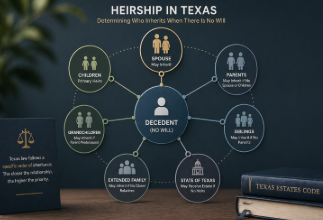
Texas intestate succession depends on family relationships and the type of property involved. A surviving spouse, children, parents, siblings, and more distant relatives may all matter depending on the situation.
Many families are surprised to learn that a spouse may not automatically receive everything, especially when there are children from another relationship or separate property involved.
- Spouse and children: Distribution depends on whether property is community or separate property and whether all children are also the surviving spouse’s children.
- Children only: The estate may pass to descendants under Texas law.
- No spouse or children: Parents, siblings, or extended family may inherit.
- No known heirs: Additional court steps may be needed to identify heirs.
Because heirship can become complex quickly, legal guidance is especially important in blended families, second marriages, estranged family situations, and estates involving real property.
How Probate Works Without a Will
When there is no will, the court process often requires more steps because there is no document naming an executor or directing who should receive property.
DeFord Law Firm explains the roles of administrators, creditors, and probate participants in this related article: Executors, Administrators, and Creditors: A Guide to Texas Probate Roles and Responsibilities.
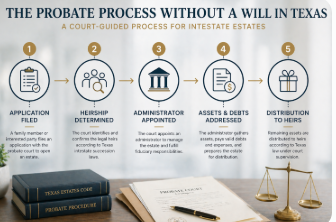
- An application is filed with the probate court
- The court determines heirs or reviews heirship evidence
- An administrator may be appointed
- Assets are identified and debts are addressed
- Remaining property is distributed under Texas law
A properly handled process protects the estate, reduces confusion, and helps prevent avoidable conflict between family members.


Common Problems in Intestate Probate
Probate without a will can create pressure at the worst possible time. Families may disagree about who should be in charge, who qualifies as an heir, what property exists, or how debts should be handled.
The legal process can also take longer because the court may need evidence about family relationships and inheritance rights before assets can be distributed.
- Disputes between heirs
- Difficulty identifying all heirs
- Delays transferring real estate or financial accounts
- Confusion over debts and creditor claims
- Higher emotional and administrative burden
If your family is facing these questions, the next step is to get clear legal direction before paperwork, deadlines, or disagreements become harder to manage.
How to Avoid This Situation in the Future
Probate without a will is often preventable. A clear estate plan can name decision-makers, direct property distribution, reduce uncertainty, and give loved ones a better roadmap.
For related planning context, read: Five Estate Planning Myths That Leave Texas Families Unprotected.
- Create a valid Texas will
- Consider trusts where appropriate
- Use beneficiary designations carefully
- Plan for incapacity with powers of attorney and healthcare directives
- Review your plan after divorce, remarriage, death, birth, business changes, or major asset changes
Helpful Probate and Estate Planning Articles
These DeFord Law Firm resources provide additional context for families navigating probate, estate administration, and planning decisions.
Understanding Texas Probate
A practical overview of the probate process and what families should expect.
Probate Roles and Responsibilities
Learn how executors, administrators, creditors, and the court fit into probate.
Estate Planning Myths
See how common misconceptions can leave Texas families exposed to avoidable probate issues.
View the full resource library here: DeFord Law Firm Articles
Probate Without a Will FAQs
What is intestate succession in Texas?
Intestate succession is the legal framework Texas uses to decide who inherits property when someone dies without a valid will.
Does everything go through probate if there is no will?
Not always. Some assets may pass outside probate through beneficiary designations, survivorship rights, or other legal mechanisms. Other assets may require court involvement.
Who becomes the administrator if there is no will?
The court appoints an administrator. This is often a close family member, but the proper appointment depends on Texas law, the estate, and any family disputes or qualifications.
How long does probate take without a will in Texas?
The timeline depends on the estate, heirs, assets, debts, and court requirements. Probate without a will may take longer because heirs must be determined before distribution can occur.
Helpful Texas Probate Resources
Get Clarity Through the Probate Process
If your family is handling probate without a will, clear legal guidance can help you move forward with confidence and avoid unnecessary complications.