
How Does Child Custody Work With a Firefighter’s Schedule?
A rotating firefighter schedule can make a traditional parenting calendar difficult to apply in real life. The important question is not simply how many parenting days appear on paper, but whether the schedule works with your actual shifts, exchanges, school obligations, and your child’s routine.
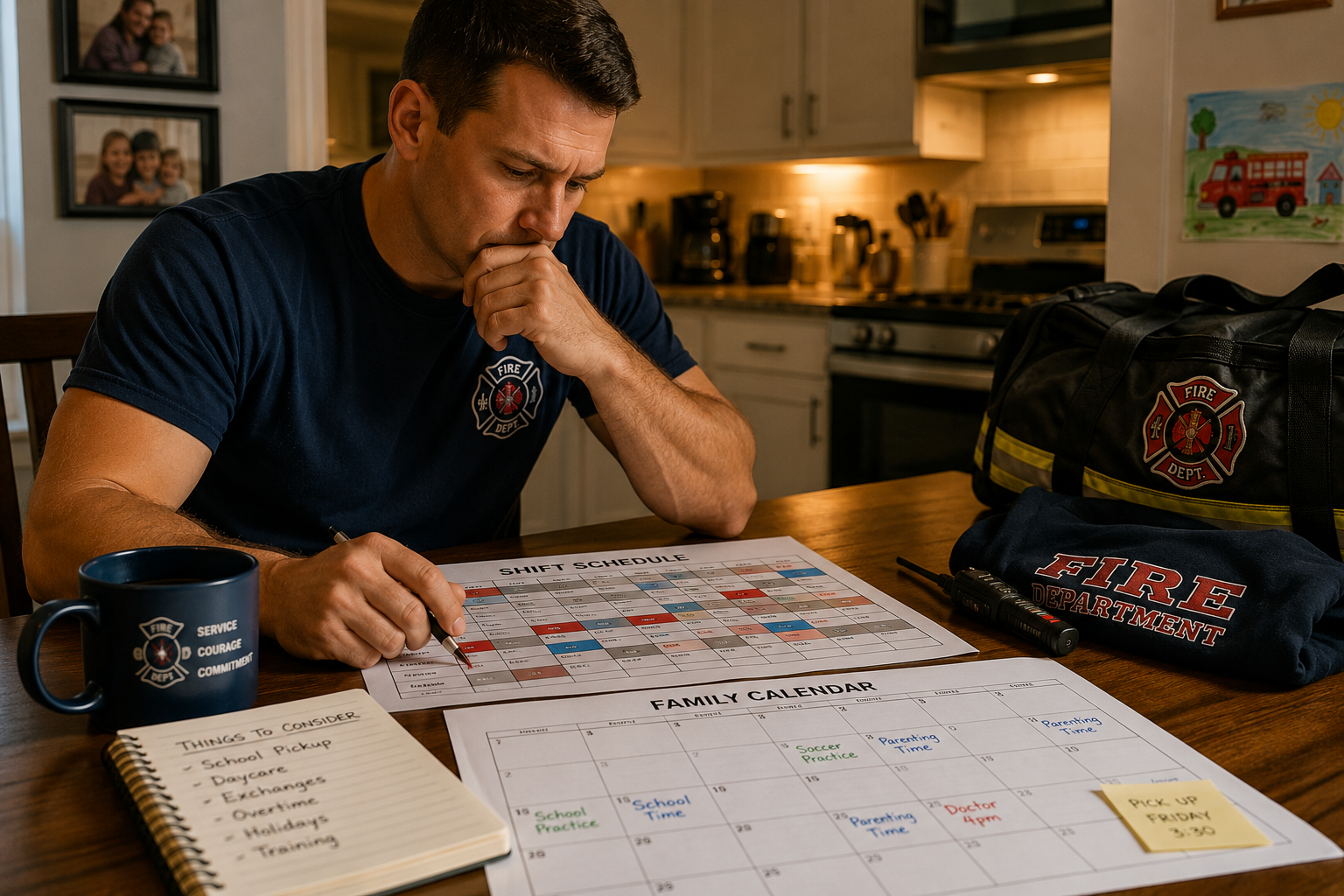
If you are wondering how child custody works with a firefighter’s schedule, you may already see a problem that a traditional parenting calendar does not capture.
Your workweek is not a traditional workweek.
If you work a rotating schedule, 24-hour shifts, nights, weekends, holidays, or training days, a traditional parenting calendar may not reflect how your life actually works.
There may be stretches when you are available while many other parents are at work, followed by long periods when you are required to be on duty.
That can lead to a difficult question:
It is understandable to worry that an unusual schedule could make you look like the less available parent. But your occupation alone does not determine what a custody arrangement should look like.
In Texas, the child’s best interest is the primary consideration in custody-related decisions. Texas also has a Standard Possession Order that provides a common framework for parenting time, but that does not mean every family’s real life fits neatly into the same calendar.
For a firefighter with rotating shifts, the more useful question may be:
Does the parenting schedule actually work when you put your real shift calendar on top of it?
That is worth figuring out before a schedule that looks reasonable on paper becomes difficult to live with every week.
Why a Standard Custody Schedule May Not Fit a Firefighter’s Rotating Shifts
When parents begin discussing custody, it is easy to focus on the calendar.
Which weekends will I have? What about holidays? Where will our child spend summer?
Those questions matter. But a firefighter or first responder often needs to go one step further.
You need to know whether you can actually perform the parenting responsibilities assigned to you on those days.
In Texas, the child’s best interest is the primary consideration when courts make decisions about conservatorship and possession and access. Texas law also provides a Standard Possession Order framework for parenting time.
The Texas Family Code Chapter 153 contains the state’s rules governing conservatorship and possession and access, including the Standard Possession Order framework.
That does not mean firefighters automatically receive a different custody schedule. It also does not mean your occupation should be evaluated without looking at when you are actually available to parent.
Put the Work Schedule Into the Custody Conversation Early
Suppose you work a repeating 24-hour rotation.
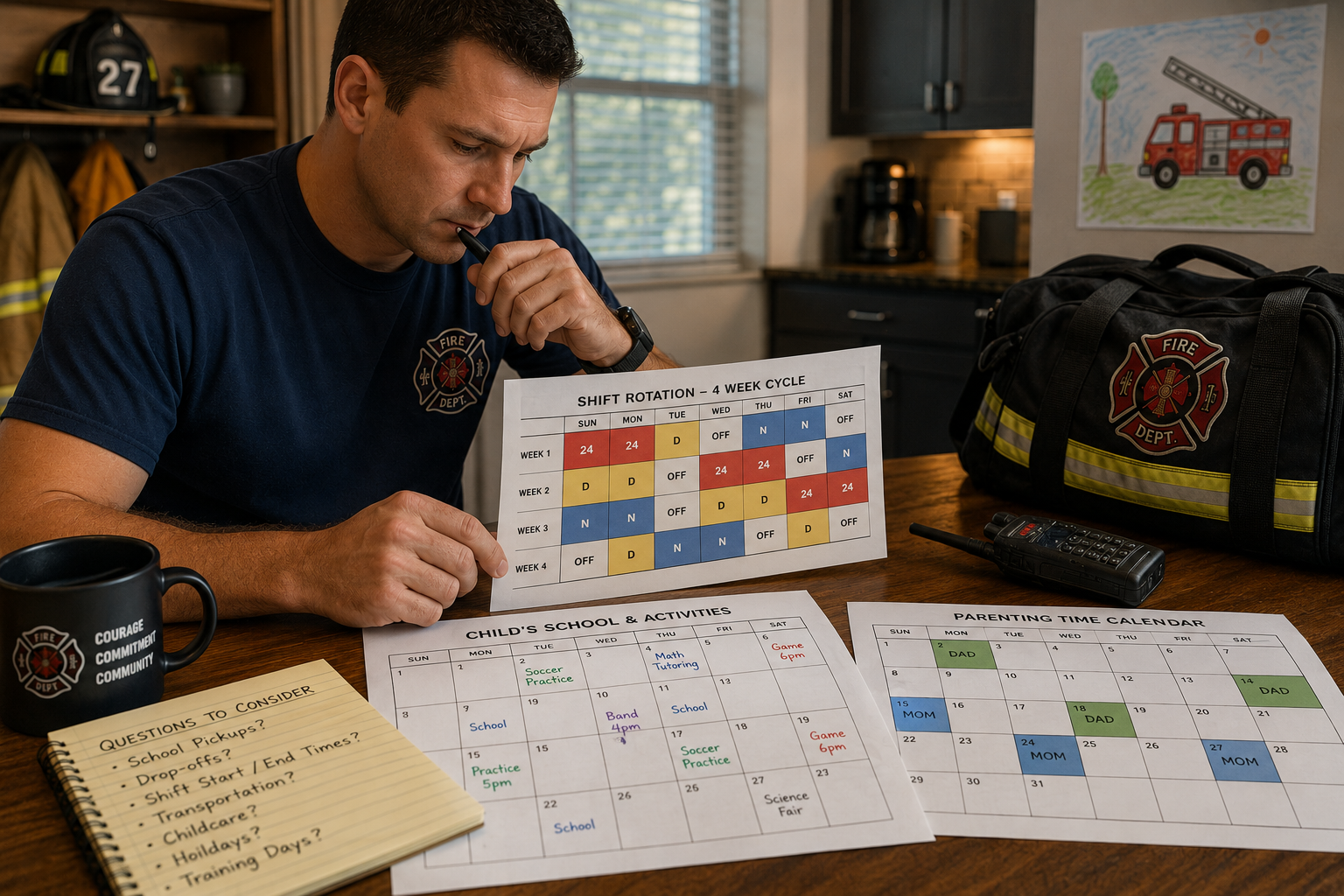
A weekend may technically be your parenting time. But if you are on duty for much of that period, simply seeing your name on the calendar does not tell you how the weekend will actually work.
The same problem can arise with nights, holidays, school pickups, training, and other work obligations.
A rotating schedule can make you completely unavailable during a shift. But that is only one side of the calendar.
Your rotation may also give you stretches of weekday or daytime availability when a parent working a traditional schedule would normally be at work.
That is why simply labeling a firefighter as having an unusual or difficult schedule does not tell the whole story.
The more useful question is when you are actually available to parent and how that availability fits with your child’s needs and routine.
Your work schedule should not become an afterthought once the parenting calendar has already been built.
The goal is not to find a way to get more days. It is to understand whether the schedule can work for your child and for the realities both parents will have to manage.

The Custody Problem Often Isn’t the Days. It’s the Handoffs.
Parents understandably pay attention to how parenting days are divided.
For first responders, however, some of the hardest problems can happen between those days.
Imagine your parenting time begins Friday afternoon.
On paper, everything looks fine.
But your shift begins Friday morning and does not end until Saturday.
Now the important questions change.
Who picks your child up from school?
Where does your child go afterward?
When can you personally take over care?
Does someone else need to help every time that shift appears in your rotation?
What happens when the same problem occurs during a holiday?
A custody schedule can divide days reasonably on paper and still create repeated problems at pickup, drop-off, school transitions, and shift changes.
Exchanges Deserve Their Own Attention
The Texas Attorney General’s pickup and drop-off guidance explains practical Standard Possession Order provisions involving exchanges. It notes, among other things, that parents can designate a competent adult to pick up or drop off a child under the applicable standard provisions.
Those details can be particularly important for first responders.
Instead of looking only at which parent has a particular day, look at the transition into that parenting time.
Ask when your shift begins compared with the exchange time. Look at when the shift ends, whether your child is in school during the exchange, who is responsible for transportation, and what happens when work overlaps with the scheduled transition.
These questions may seem small compared with deciding the overall custody arrangement.
In everyday life, they can determine whether that arrangement runs smoothly or repeatedly requires another solution.
What Happens When Your Parenting Plan Depends on Constant Schedule Swaps?
First responders are used to adjusting.
That flexibility can carry over into co-parenting.
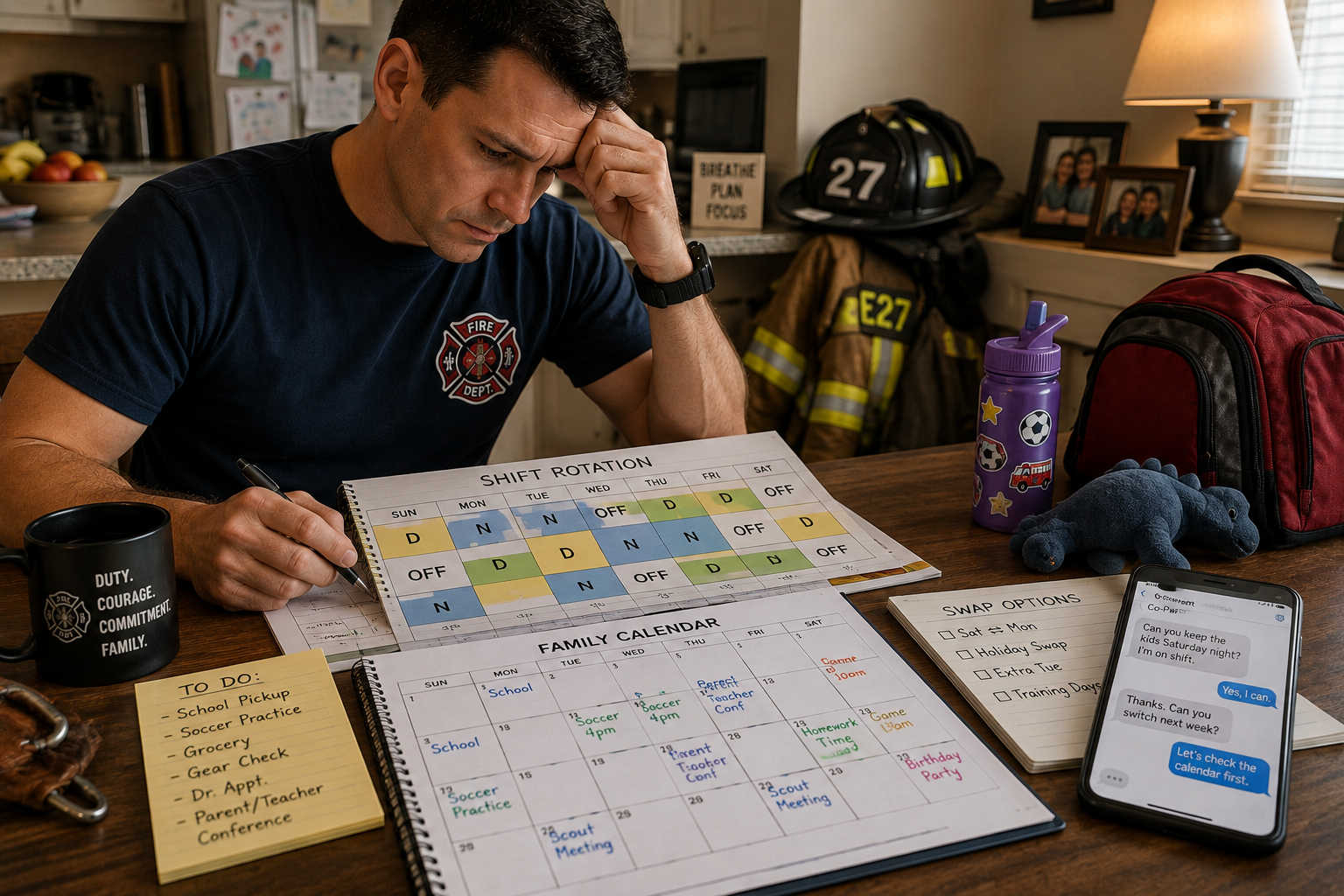
Maybe your current arrangement works through conversations like:
“I’m on shift Saturday. Can we switch?”
“I got held over. Can you keep the kids tonight?”
“I’m working the holiday. Can I take the following day instead?”
When both parents cooperate, those adjustments may feel manageable.
The problem is not that parents are willing to be flexible.
Flexibility can be valuable. But flexibility and predictability are not the same thing.
The warning sign is not that parents occasionally switch days. It is that the ordinary parenting schedule works only when they repeatedly renegotiate it.
Constant Renegotiation Can Become the Schedule
A plan that requires occasional adjustment is different from one that works only because both parents continually change it.
Repeated swaps can make it harder to plan childcare, activities, transportation, family events, and time with each parent.
They can also create unnecessary opportunities for misunderstanding.
That does not mean you should assume the other parent will stop cooperating.
It means the parenting plan should ideally be clear enough that cooperation is a benefit rather than the only thing holding the schedule together.
For your child, predictability matters too.
Are You Creating a Schedule or Dealing With One That Already Doesn’t Work?
There is an important difference between identifying scheduling problems before a parenting plan is finalized and realizing those problems after a custody order is already in place.
If you are creating a parenting plan now, the Real-Schedule Stress Test below can help identify predictable conflicts before they become part of your regular routine.
If you already have a custody order, identifying recurring conflicts with your shift schedule does not automatically change what the order requires.
Changing an existing order is a separate legal question, so start by understanding the terms of your current order and where your real work schedule is creating recurring problems.
Texas Access also explains an important practical distinction: parents may agree to a different parenting schedule, but when an alternative agreement stops working, the court-ordered schedule remains important unless the order is changed.
Additional parenting-time resource: Texas Access: Standard Possession Order and Parenting Time FAQs
Either way, the practical first step is the same:
Find out where your real work schedule and parenting schedule actually collide.
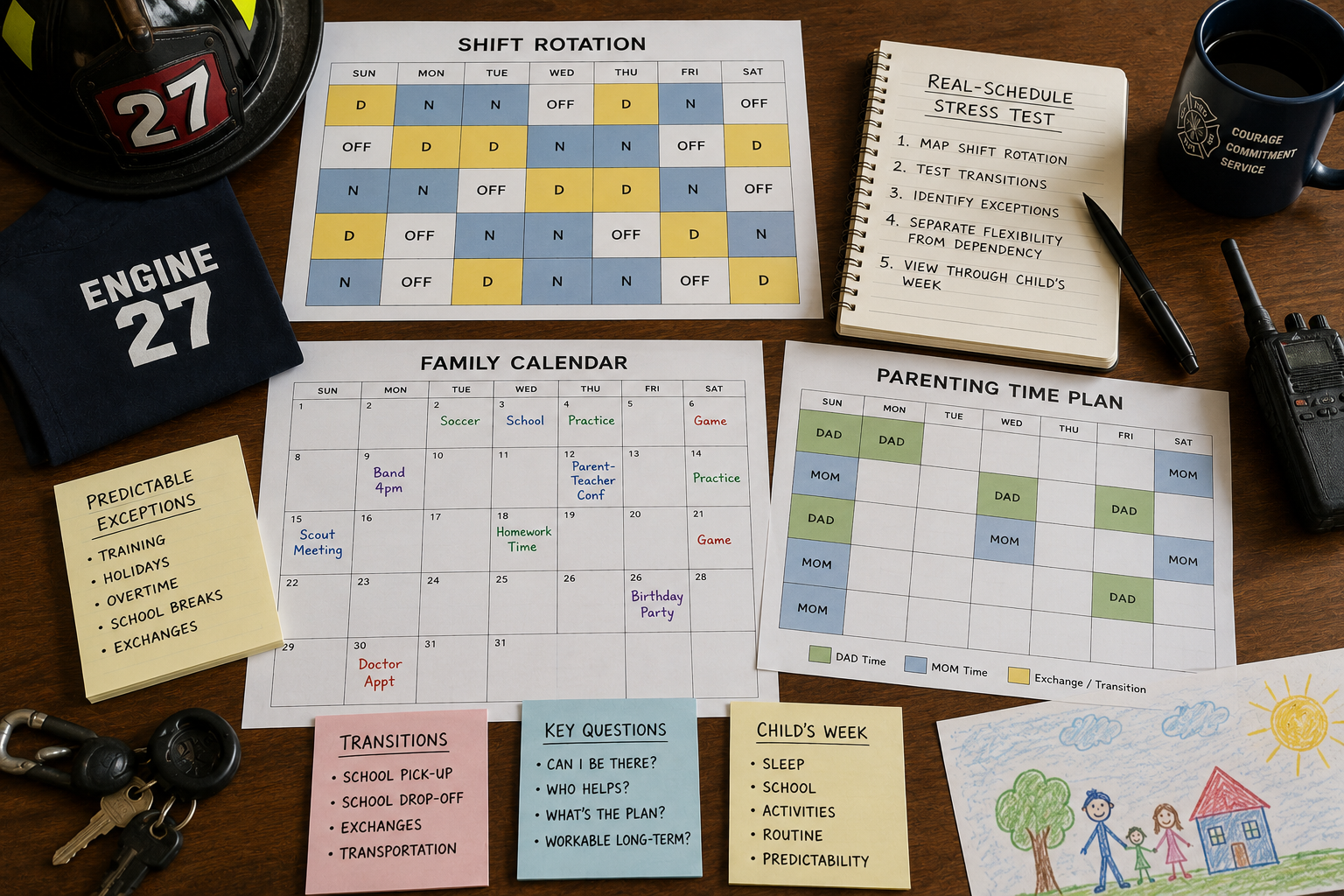
The Real-Schedule Stress Test for a Firefighter Custody Schedule
Before deciding that a parenting schedule works, test it against real life.
Do not rely only on a sample week. Use your actual rotation.
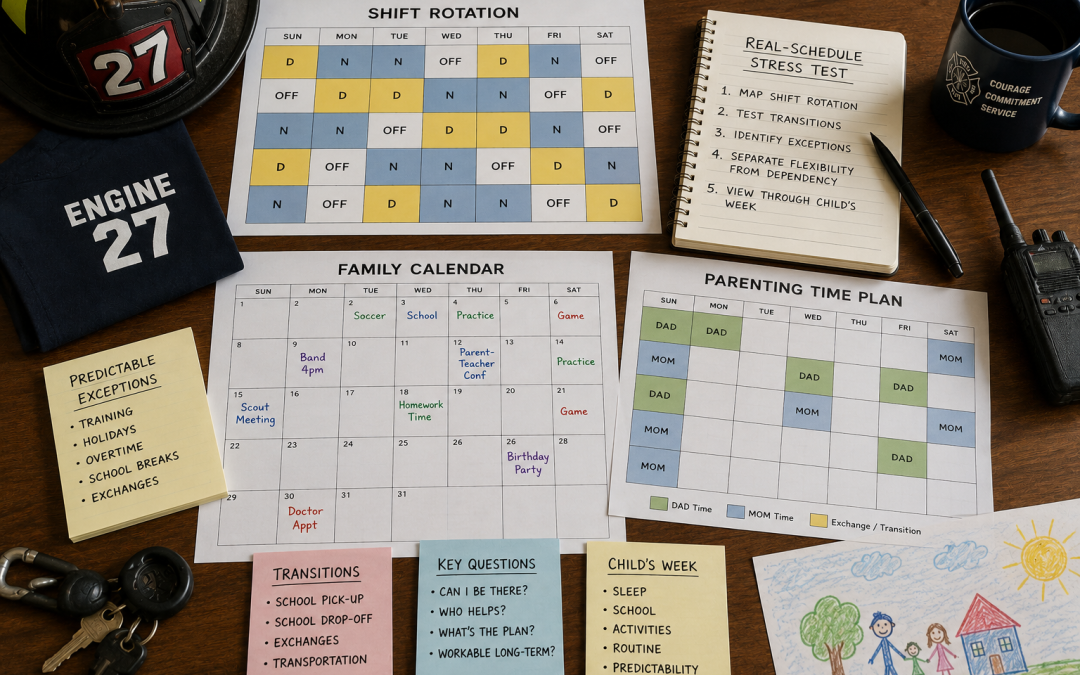
The Real-Schedule Stress Test helps you determine whether a proposed parenting plan works with your actual rotation instead of judging it only by the number of parenting days on the calendar.
Map → Test → Identify → Separate → View
Mark your duty days across several weeks or months, if your schedule allows.
Include regular shifts, nights, weekends, holidays, scheduled training, and other predictable work obligations.
Then place the proposed parenting schedule over it.
Where do the conflicts appear?
You may also discover periods when your rotation makes you particularly available to parent.
The purpose is not to prove that your schedule is good or bad. It is to see your actual availability clearly.
Do not stop at overnight counts.
Check school pickups and drop-offs, daycare, exchange times, shift starts and endings, and transportation.
Then ask: Can I actually perform the parenting responsibilities this schedule assigns to me?
A calendar can look balanced by overnight count while still creating the same transition problem again and again.
Look for recurring situations such as a shift overlapping an exchange, scheduled training changing your rotation, a holiday falling on a duty day, or school being closed.
You cannot plan for every unexpected event.
Focus on the conflicts you can already see coming.
Ask: Does this schedule work on its own, or does it work only if the other parent regularly agrees to change it?
Cooperation is valuable.
But there is a difference between choosing to be flexible and depending on repeated schedule changes to make ordinary parenting time work.
Finally, stop looking at the calendar only as Parent A’s time and Parent B’s time.
Consider sleep, school, activities, transportation, childcare, transitions, and predictability.
Then ask: What does my child actually experience under this schedule?
That is ultimately more useful than simply counting days.

What a Workable First Responder Parenting Plan Looks Like
There is no single parenting schedule that is right for every firefighter or first responder.
Different departments, positions, rotations, children, school schedules, distances between homes, and family circumstances can produce very different needs.
So success should not be defined as:
“I got exactly half the days.”
Nor should it be:
“The other parent has to work around my job.”
A stronger outcome is a parenting plan in which the predictable parts of your work and your child’s life have actually been considered.
You understand when your parenting time occurs.
You understand how exchanges work.
You know where your regular shift conflicts are.
You know how the schedule interacts with school.
And the arrangement does not require everyone to rediscover the same scheduling problem every few weeks.
A poor outcome may sound like:
“The schedule looked fair when we agreed to it, but I’m constantly asking to switch days because I’m working during my parenting time.”
A stronger outcome sounds more like:
“We put my actual rotation against the proposed parenting schedule and dealt with the predictable conflicts before they became recurring problems.”
Your work schedule does not define how committed you are as a parent. But pretending that schedule does not exist will not make parenting easier for your child.
The goal is to create an arrangement grounded in the life your family actually has.
Frequently Asked Questions About Firefighter Custody Schedules in Texas
How does child custody work for firefighters with rotating schedules in Texas?
Texas does not determine custody based solely on whether a parent is a firefighter or works rotating shifts. The child’s best interest remains the primary consideration in decisions involving conservatorship and parenting time. Texas has a Standard Possession Order framework, but the circumstances of the family can matter when determining a workable schedule. For a firefighter, that makes the interaction between the parenting plan and the actual shift rotation especially important.
Can a firefighter have a different custody schedule from the Texas Standard Possession Order?
Potentially. Texas’s Standard Possession Order provides an important framework, but it is not accurate to assume that every family must use exactly the same parenting schedule regardless of its circumstances. Whether a different arrangement is appropriate depends on the situation and the child’s best interest. Being a firefighter alone does not create an automatic right to a particular schedule.
Can working 24-hour shifts affect a custody schedule?
A 24-hour shift can create practical issues that should be considered when developing a parenting schedule. Parenting time may overlap with work, exchange times, school pickup, or other responsibilities. That does not automatically determine the custody outcome. It does mean the proposed schedule should be evaluated against the parent’s real work obligations rather than assuming every assigned day will function the same way.
Will working nights hurt my chances of getting custody in Texas?
Night-shift work alone does not answer a custody question. Texas custody decisions focus on the child’s best interest rather than deciding the issue based on one fact in isolation. The practical effects of a parent’s schedule may still matter. That is why childcare, availability, school routines, transportation, and other circumstances should be understood as part of the larger picture.
What if my firefighter shift falls during my parenting time?
The answer can depend on the terms of your parenting order and your circumstances. Do not assume there is a universal rule that automatically replaces parenting time whenever work creates a conflict. If predictable shift conflicts repeatedly overlap with your parenting time, that may be a sign that the schedule itself deserves closer review.
Can parents agree to switch custody days around a rotating work schedule?
Parents may be able to agree on parenting-time arrangements and adjustments, depending on their circumstances and the terms of the applicable order. Cooperation can be extremely useful for first responder families. But if ordinary work shifts require constant changes, it is worth asking whether the underlying parenting schedule reflects the family’s real life clearly enough.
What should firefighters consider when creating a parenting plan?
Start with your actual work rotation rather than a hypothetical week. Compare duty days, shift start and end times, school schedules, exchanges, transportation, holidays, childcare needs, and predictable work conflicts with the proposed parenting plan. Then look at the schedule from your child’s perspective and ask whether it creates a reasonably workable routine.
What if my current custody order no longer works with my shift schedule?
An existing order is different from creating an original parenting plan. If your current order no longer works with your employment schedule, do not assume that informal changes automatically change what the order requires. The specific order and circumstances matter. Understanding what the existing order says is the appropriate starting point before deciding what legal options may be available.
Can someone else pick up my child if I am still on shift?
Texas Standard Possession Order provisions can allow a parent to designate a competent adult to pick up or return the child. Your actual order still matters, so review its transportation and exchange terms rather than assuming every custody order handles third-party pickup the same way.
Should a parenting plan address mandatory overtime or schedule changes?
A parenting plan cannot predict every unexpected event. But if certain work conflicts are common or reasonably predictable, considering how they interact with parenting time can reduce recurring uncertainty. The goal is not to eliminate the need for flexibility. It is to keep ordinary first responder scheduling issues from requiring the parents to rebuild the parenting plan every time they occur.
Build the Parenting Schedule Around Real Life, Not an Ideal Calendar
If you are a firefighter or first responder, you may have started with the question:
Is my work schedule going to cost me time with my child?
Your work schedule alone does not answer what your custody arrangement should be.
A more useful question is:
Does the proposed parenting schedule actually work when I put my real shift calendar against it?
Look beyond the number of days.
Look at your duty schedule, exchanges, school days, transportation, weekends, holidays, childcare, and the routine your child will actually experience.
Flexibility between parents can be valuable.
But a parenting plan should be workable enough that normal life does not require constant renegotiation.
Your unusual work schedule does not make you a less committed parent. It does mean the schedule deserves to be tested against reality before you rely on it.
Make Sure the Schedule Works in Real Life
When you are ready, contact De Ford Law Firm to set up a time to talk. We can help you understand which scheduling questions should be addressed before a parenting plan becomes your family’s new normal.
Contact De Ford Law Firm