
TEXAS PROBATE
Small Estate Affidavit in Texas
When a loved one passes away with limited assets, families often want to know whether full probate is really necessary.
A Small Estate Affidavit may help in certain Texas estates, but it is not available in every situation. DeFord Law Firm helps families determine whether this simplified probate option applies and what steps are required to move forward correctly.
Probate alternatives
Heirship and asset guidance

What Is a Small Estate Affidavit in Texas?
A Small Estate Affidavit is a simplified Texas probate procedure that may allow heirs to collect certain estate assets without opening a full estate administration.
This option is designed for limited estates that meet strict legal requirements. It can be helpful when the person died without a will, the estate is relatively small, and the heirs can provide the information required by the court.
The key issue is qualification. Filing a Small Estate Affidavit when the estate does not meet Texas requirements can lead to rejection, delay, and additional legal work.
- May help avoid full probate administration
- Generally applies when there is no valid will
- Requires court review and approval
- Works only when the estate meets Texas statutory requirements

When Can You Use a Small Estate Affidavit?
Families are often told to “just file a Small Estate Affidavit,” but that advice can be misleading. Texas courts require specific facts before approving this procedure.
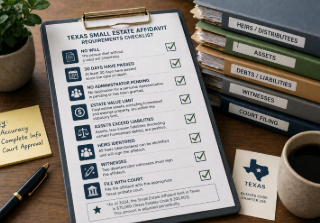
A Small Estate Affidavit may be available when the person died without a will, enough time has passed since death, no full administration is pending or already granted, and the estate value and debts meet Texas requirements.
- The person died without a valid will
- At least 30 days have passed since death
- No personal representative has been appointed
- The estate value falls within Texas small estate limits
- Assets exceed known liabilities, subject to Texas rules
- All heirs can be properly identified
For a broader explanation of Texas probate procedures, see DeFord Law Firm’s article: Understanding the Texas Probate Process: What Families Need to Know.
What Assets Can a Small Estate Affidavit Help Transfer?
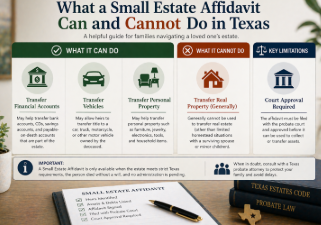
A Small Estate Affidavit may help heirs collect or transfer certain estate assets, but it is not a universal shortcut for every type of property.
It is often used for limited bank accounts, personal property, vehicles, and other qualifying assets. Real estate requires special caution. Homestead property may be addressed only in narrow circumstances, and other real estate issues may require a different probate process.
- Bank accounts
- Vehicles
- Personal property
- Limited estate assets that qualify under Texas law
- Homestead property only in limited circumstances
Because every estate is different, legal review can help determine whether a Small Estate Affidavit is the correct path or whether another probate option is safer.

When a Small Estate Affidavit May Not Work
The biggest risk is assuming the estate qualifies when it does not. If the affidavit is incomplete, inaccurate, or unavailable under Texas law, the court may reject it and require another process.
This can happen when there is a will, the estate is too large, heirs disagree, debts exceed assets, or property issues are more complex than expected.
- There is a valid will
- Estate assets exceed the statutory limit
- Heirs cannot be identified or located
- Family members disagree
- Debts or creditor issues create complications
- Real estate transfer issues require another probate route
If a Small Estate Affidavit is not available, there may still be other probate options. The right path depends on the estate, the assets, the heirs, and the court requirements.
How the Small Estate Affidavit Process Works
A Small Estate Affidavit is still a legal court filing. The information must be complete, accurate, and supported by the proper signatures.
1. Confirm eligibility
We review the estate, assets, debts, heirs, and whether the Texas small estate procedure is available.
2. Prepare the affidavit
The affidavit must identify the heirs, estate assets, liabilities, family history, and required legal facts.
3. File and use approval
After court approval, the affidavit may be used to collect or transfer qualifying estate assets.
For more on probate roles and creditor issues, read: Executors, Administrators, and Creditors: A Guide to Texas Probate Roles and Responsibilities.
Helpful Probate and Estate Articles
These DeFord Law Firm resources provide additional context for families handling probate, estate administration, and next steps after a loved one passes away.
Understanding the Texas Probate Process
Learn how probate works and why the right procedure matters.
Executors, Administrators, and Creditors
Understand estate roles, responsibilities, and creditor concerns.
What to Do After a Spouse Dies
A practical guide for families facing loss and legal next steps.
View all resources here: DeFord Law Firm Articles
Small Estate Affidavit FAQs
Can I use a Small Estate Affidavit if there is a will?
Usually no. Texas Small Estate Affidavits are generally used when the person died without a valid will. If there is a will, another probate option may be required.
Does a Small Estate Affidavit avoid probate?
It may avoid full estate administration, but it is still filed with and reviewed by the court. It is a simplified probate procedure, not a private transfer document.
Can a Small Estate Affidavit transfer a house?
Only in limited circumstances. Homestead issues require careful review, and many real estate situations need a different probate process.
Do all heirs have to sign a Small Estate Affidavit?
The affidavit must identify the heirs and generally requires signatures from distributees and disinterested witnesses. Exact requirements depend on the facts of the estate and the court.
Helpful Texas Small Estate Resources
Find the Right Probate Path Before You File
A Small Estate Affidavit can be useful when the estate qualifies—but the wrong filing can create delay. DeFord Law Firm can help you determine the correct next step.
Recent Comments