
TEXAS ESTATE PLANNING FOR BUSINESS OWNERS
Business Succession Planning in Texas
What happens to your business if you retire, become incapacitated, or pass away unexpectedly?
Without a clear succession plan, your family, partners, employees, and clients may be left facing uncertainty, ownership disputes, operational disruption, or probate delays. DeFord Law Firm helps Texas business owners protect what they have built with succession plans aligned with their estate plan, business structure, and long-term goals.
Estate plan coordination
Legacy protection

What Is Business Succession Planning?
Business succession planning is the process of preparing for the transfer of business ownership, management, and control when an owner retires, becomes incapacitated, exits the company, or passes away.
For Texas business owners, succession planning often involves more than one document. It may include company agreements, buy-sell provisions, trusts, wills, powers of attorney, tax planning, and clear instructions for who should own, manage, or receive value from the business.
The goal is to keep the business stable while protecting your family, your partners, your employees, and the value of the company you built.
- Plan for retirement, incapacity, death, or sale
- Clarify who receives ownership and who controls operations
- Coordinate business documents with your estate plan
- Reduce the risk of disputes, delays, and forced decisions

Why Succession Planning Matters for Texas Business Owners
A business can lose value quickly when no one knows who has authority to act. The absence of a succession plan can create confusion between family members, co-owners, managers, creditors, and customers.
Texas business entities are governed by the Texas Business Organizations Code, and each company’s governing documents can significantly affect what happens after an owner dies, exits, or becomes unable to act. For an LLC, the company agreement is especially important because it can define management rights, transfer restrictions, and continuity rules.
You spent years building the business. A succession plan helps prevent its future from being decided under pressure.
- Protect business value
- Reduce ownership disputes
- Support family and employee stability
- Prepare for tax, probate, and transition issues
Key Parts of a Strong Business Succession Plan
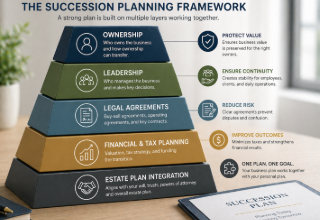
A strong succession plan should address ownership, control, valuation, tax exposure, incapacity, and family expectations. The right structure depends on your business entity, ownership arrangement, and long-term goals.
- Ownership transfer strategy: Determines whether ownership passes by sale, gift, inheritance, trust, or buyout.
- Buy-sell agreement: Establishes what happens if an owner dies, becomes disabled, retires, divorces, or exits.
- Leadership transition plan: Identifies who runs the company day to day.
- Estate plan coordination: Aligns your business interest with your will, trusts, and beneficiary planning.
- Incapacity planning: Uses tools like a Power of Attorney to avoid authority gaps.
Business succession planning should be practical, not theoretical. The plan should work in real life, under pressure, and with the people who will actually carry it out.

What Happens Without a Business Succession Plan?
Without a plan, your business interest may become tied up in your estate, your heirs may receive economic rights without clear management authority, or co-owners may disagree over valuation and control. The result can be delay, lost revenue, and damage to the business’s long-term value.
For many Texas owners, the biggest risk is not just who inherits the business. It is whether the business can keep operating while ownership, authority, and legal control are being sorted out.
DeFord Law Firm helps business owners plan before that pressure exists, using coordinated estate planning, company documents, and transition strategies designed around the business’s real needs.
How We Help You Build a Succession Plan
Our process is designed to connect your business documents, estate plan, and long-term transition goals.
1. Review the business structure
We look at your entity type, ownership documents, company agreement, management structure, and transfer restrictions.
2. Define the transition plan
We help identify successors, buyers, family roles, leadership authority, and valuation concerns.
3. Coordinate legal documents
We align your succession plan with wills, trusts, POA documents, buy-sell provisions, and related planning tools.
Texas Business Succession Planning FAQs
What happens to my business if I die without a succession plan in Texas?
Your ownership interest may pass through your estate, and the business may face delays while authority, ownership, and control are determined. The exact result depends on your entity documents, estate plan, ownership structure, and Texas law.
Do I need a trust for business succession planning?
A trust is not required in every case, but it can be useful when a business owner wants continuity, privacy, probate avoidance, or structured management of business interests for family members.
What is a buy-sell agreement?
A buy-sell agreement is a legal arrangement that sets rules for how an owner’s business interest may be bought, sold, valued, or transferred after certain events such as death, disability, retirement, or exit.
Can I transfer my business during my lifetime?
Yes. Many succession plans include lifetime transfers, phased ownership transitions, gifts, sales, or restructuring. The right approach depends on tax, control, valuation, and family considerations.
Should my business succession plan connect to my estate plan?
Yes. Your business succession plan should coordinate with your will, trusts, powers of attorney, beneficiary designations, and tax planning so your business and personal estate plan work together.
Helpful Texas Business Succession Resources
For additional legal and tax context, these official resources may be helpful:
Protect Your Business, Your Family, and Your Legacy
A well-designed succession plan gives you control over what happens next, so your business can continue with clarity and purpose.